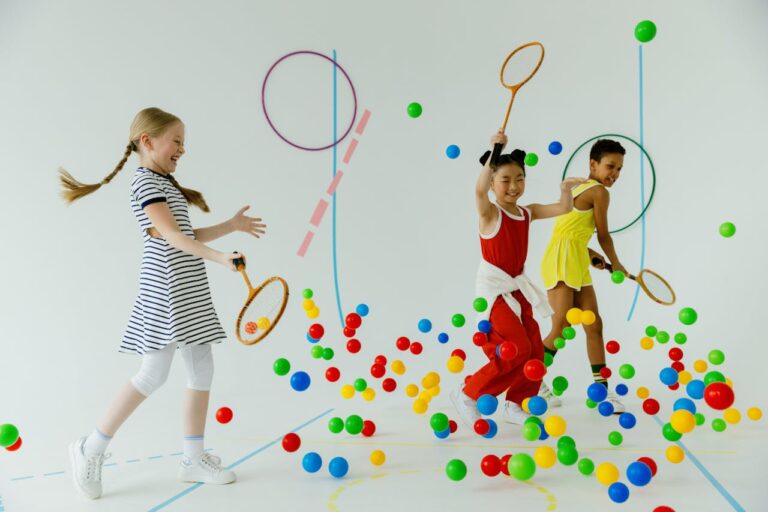
Agility Games in a Dry Pool Time spent in a dry pool, as well as playing with pool balls outside the pool, can not only be fun for a child but also help improve their physical fitness and coordination. By organizing fun physical activities for your little one using colorful pool balls, so we can successfully combine business with pleasure. What activities that support a toddler’s motor skills, fitness, and dexterity should we include in their play schedule? The Role of Physical Play in Child Development Physical play is particularly important and beneficial for a child’s healthy development. It helps develop and practice motor skills, and also supports the ability to control one’s own body. Games and activities that promote physical fitness, as well as age-appropriate physical activity, support the healthy development of the skeletal, respiratory, and circulatory systems. Lung and heart capacity increase, and overall fitness improves. Physical activity supports cognitive skills and has a positive impact on the development of so-called gross motor skills, which in turn contributes to the proper development of fine motor skills—including hand movements. Pool balls in simple movement games What kinds of physical activities featuring pool balls can we organize for a toddler? There are so many possibilities! Let’s start with the simplest activities: for example, you could play together by throwing balls into the pool, or a game where you take all the balls out of the pool and put them back in. We can also organize a ball-tossing contest. The whole family can take part in this game. All you need to do is set up a few targets of different sizes around the room—these can be bowls, basins, or small plastic cups. Each participant takes turns trying to hit a chosen target. The smaller the target, the more points you’ll earn for a successful throw. An interesting game that helps develop agility and coordination is passing a ball from your feet to your hands. To play this game, sit on the floor and place the ball between your feet. Now lie on your back and slowly lift your legs up, trying to keep the plastic ball between your feet. When you’re ready, bend forward and catch the ball in your hands. Then lie flat on your back and repeat the movement, moving the ball in the other direction. Agility games with several pool balls Plastic balls also work well for many slightly more challenging games and activities. Using three colorful balls, we can try, together with our little one, to learn the impressive art of juggling. This activity is, of course, suitable for slightly older children. Learning together how to control three balls at the same time will not only help develop your child’s dexterity and coordination, but it will also be a great way to spend some active time together. If we have a few little ones at home, we can organize some agility races for them, with plastic balls taking center stage. In this game, we’ll also use our imagination and creativity to build the race course. We can line the track with pillows, lay out colorful strings, or mark the path with wide tape. Now all that’s left is to get the racers ready. Each child receives a large tablespoon or another kitchen spoon with a plastic pool ball placed on it. The rules of the game are similar to an egg race—the first one to reach the finish line without dropping the ball wins. A huge advantage of this game is that the course can be different every time—getting longer, more varied, and more interesting! Outdoor physical activities Thanks to their durability and high resistance, these colorful plastic balls are also perfect for outdoor play—in the garden or on the playground. Whether it’s just one child or a larger group, we can organize a group hunt for the balls hidden around the area. First, a parent or caregiver hides a dozen or so pool balls in a designated area, and then the children—on their own or in groups—begin their search. We can add various twists to the game, such as guiding the children to the balls using the words “hot” and “cold” or providing more detailed clues. In addition to the colorful balls, you can also hide other toys or treats to make the game even more fun. High-quality plastic balls for a dry pool also work perfectly in a traditional pool filled with water. They float on the water, adding variety to swimming or pool play. If you have a slightly larger pool, you can organize a competition to see who can swim to the balls and retrieve them the fastest. The person who reaches a ball first or collects the most colorful balls wins. Of course, there are many more possibilities—there’s no shortage of ideas for games to play in the garden or in the comfort of your own home. It’s worth using your imagination or organizing a family brainstorming session to come up with a completely new, interesting game that’s uniquely yours! Active Play with Pool Balls—What Should You Keep in Mind? Let’s remember that the most important thing in any play activity should be, above all, the child’s safety. That’s why you should always choose activities that are appropriate for the child’s age and abilities. For younger children, parents should supervise play at all times—especially in the water and outdoors, in open spaces. If we use colorful pool balls in active games, let’s make sure they are of impeccable quality. All plastic balls should be made of high-quality, odorless, and hypoallergenic material. They must be highly durable enough to withstand long-term, regular, and intensive use. That’s exactly the kind of pool balls we offer. Take advantage of contact form or visit the homepage to learn more about our offerings Everplast.